Closing the Gap Between Evidence, Casework and Oversight
Most agencies assume forensic backlogs come down to headcount or instrumentation, and that adding either one will fix the timeline. Anyone who has spent real time in a lab knows it’s rarely that simple. Accreditation adds another layer, and anyone who has pulled together calibration records, training documentation and proficiency testing the week before an ISO/IEC 17025 or 17020 review knows what that costs. When that documentation lives apart from the casework it supports, audit preparation becomes its own project instead of something that happens quietly in the background.
The labs making the most progress are pairing that investment with a closer look at the full system, evidence, quality data and the connection back to the investigation, and they’re finding real time back for the people who need it most.
Keep Evidence Organized From Intake Through Court
Evidence needs to reach the right discipline in a form analysts can use, and it needs a documented chain of custody. These should be built into the daily workflow, not in separate systems.Make Quality Management Part of the Daily Workflow
Quality documentation that lives apart from casework turns every audit into a scramble, and a scramble is exactly what accreditation is supposed to prevent. Calibration records, training documentation and proficiency testing work best when they're part of how the lab operates day to day, not a separate exercise squeezed in before a review.Keep the Lab Connected to the Case and the Investigator
A forensic result that stays inside the lab's system only tells half the story. Findings need to reach investigators, prosecutors and the RMS case record without a manual export step, so the evidence can do what it's there to do: move the case forward.A Connected Approach to Forensic Operations
A forensic lab is more than the sum of its instruments. Effective operations span discipline-specific casework, quality governance and chain-of-custody tracking, digital and archival evidence and the wellbeing of the people doing the work. Versaterm offers solutions across all of it.
Versaterm Forensics
Versaterm Forensics (Versaterm LIMS-plus) brings evidence tracking, discipline-specific workflows and quality documentation into one continuous system. Configurable fields and reporting templates adapt to toxicology, DNA, trace and other disciplines without losing centralized oversight of the lab. An optional client-facing Portal lets submitting agencies simplify case submissions and receive results securely, without added coordination overhead.
Versaterm RMS
Versaterm RMS carries case and investigative data between the records system and the forensic lab, so findings don’t sit in a separate system waiting for someone to reconcile them. Advanced link analysis within the RMS visually displays associations between people, places and events, helping investigators spot connections that forensic results alone wouldn’t surface.
Versaterm Visual Labs DEMS
Versaterm Visual Labs DEMS unifies multiple sources of footage into one secure, cloud-based platform, with synchronized playback that lets investigators align multiple angles of an incident and review them together. The platform also reduces the administrative work around evidence.
AI-driven redaction automates blurring for public release, and advanced search, tagging and retention scheduling help investigators locate the right file without combing through unrelated footage, all within a CJIS-compliant environment with full audit trail support.
Versaterm Document Conversion
FOR LABS DIGITIZING ARCHIVAL CASE FILES, MICROFILM AND FORENSIC RECORDS
Forensic labs often carry decades of archival case files, microfiche and docket books that predate any digital system, records that are just as vulnerable to loss and just as hard to search as physical evidence sitting in storage. Versaterm Document Conversion turns those hard copy files into searchable, indexed digital records with OCR indexing that makes every word searchable and role-based access control that keeps sensitive files protected.
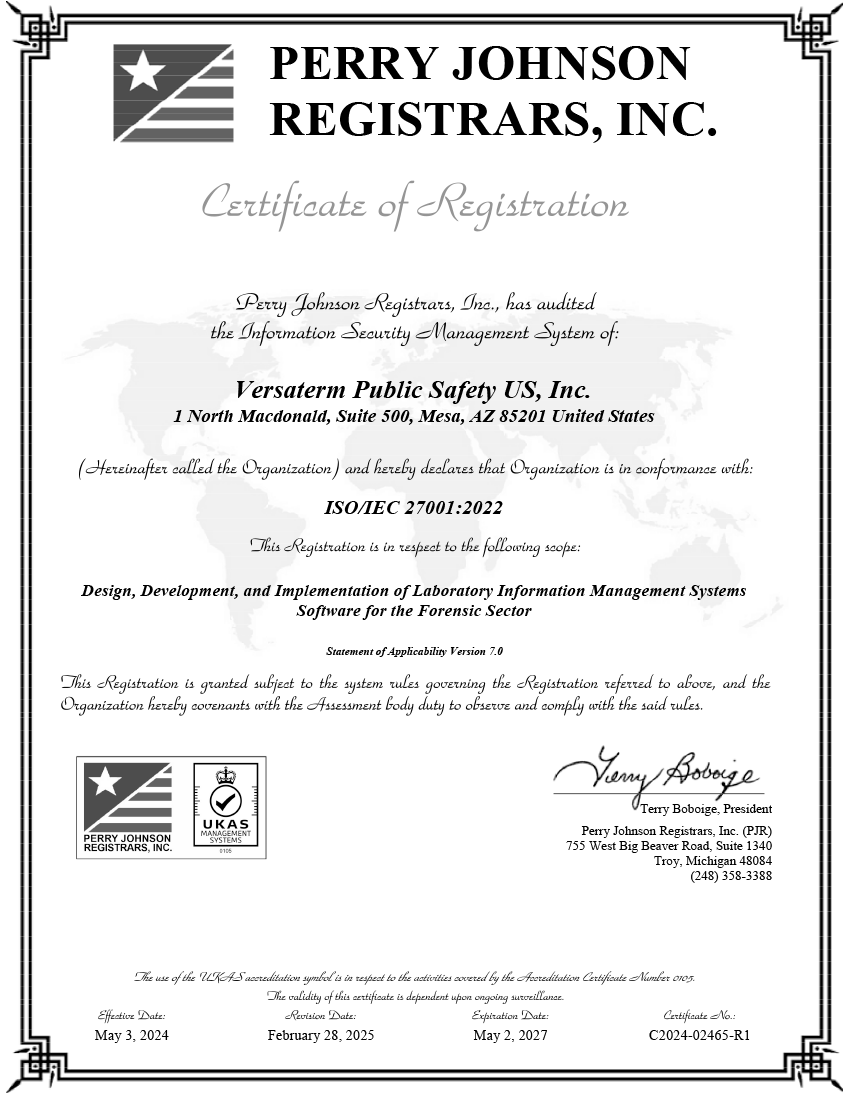
Versaterm Forensics is ISO 27001:2022 Registered for Information Security
GUIDE
Strengthening the Systems Around Forensic Science
Use this guide to uncover the connections between evidence tracking, quality documentation and the wider case record that turn added capacity into throughput.
DOWNLOADStrengthen Your Lab’s Path From Evidence to Answers
See how Versaterm’s forensic solutions fit your lab’s disciplines, accreditation requirements, caseload and the people behind every case.