
Why Agencies Must Build for the Voice No One Sees
When communities think about public safety, they often picture the responders who arrive to help. But every response begins with someone the public rarely sees: the dispatcher behind the headset who turns a crisis into a coordinated response.
Dispatchers are often the first connection someone has in a time of need. Before help arrives, they are listening, gathering critical information and providing reassurance to people experiencing some of their most difficult moments, all without ever seeing the person on the other end of the line.
The Pressure Behind Every Call
Emergency communications centers and public safety answering points are facing growing demands. According to NENA, a significant share of call volume received by emergency communications centers is non-emergency, creating additional workload for already stretched teams.
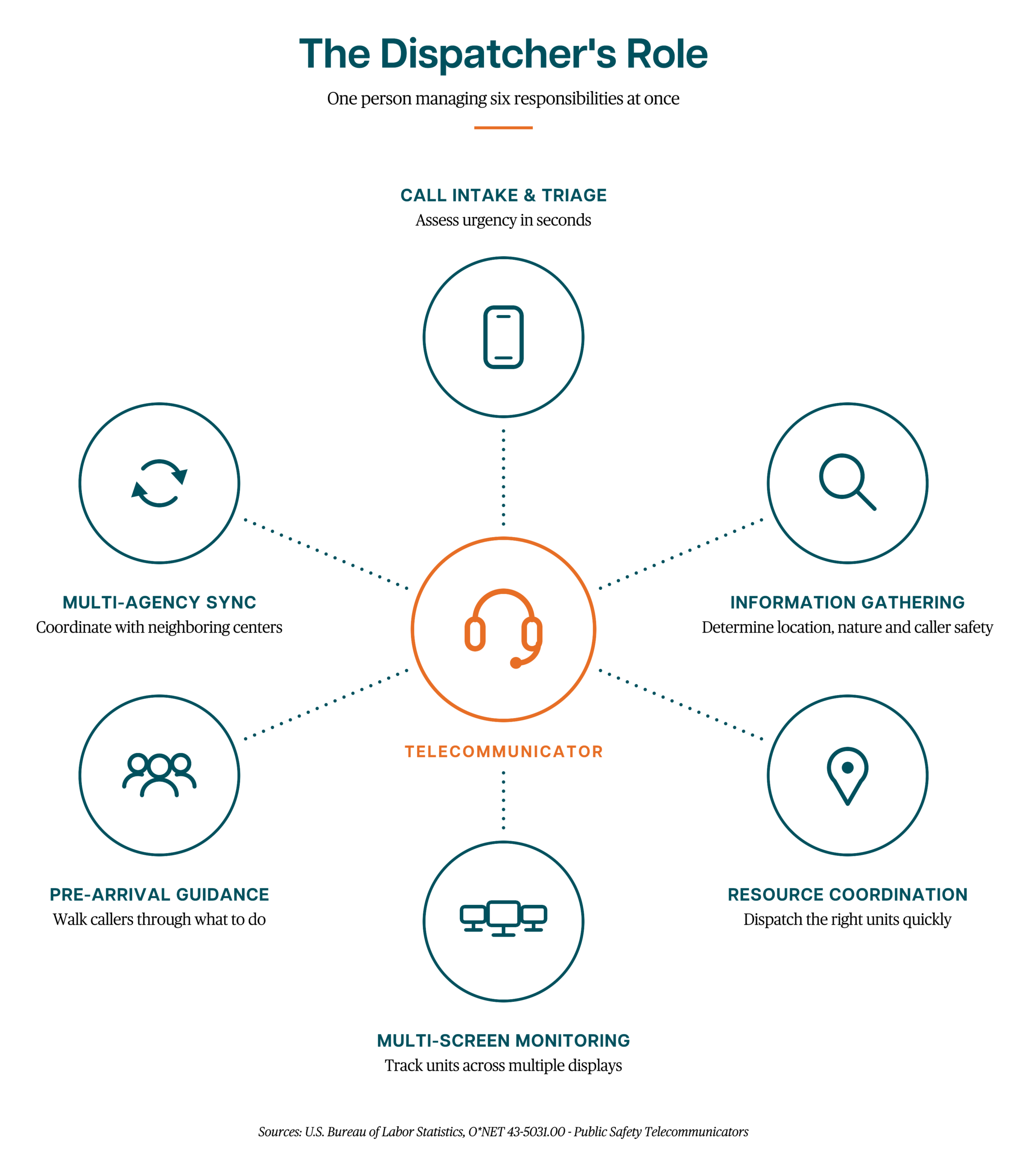
Dispatchers manage that growing pressure while making critical decisions in seconds and balancing demands that extend well beyond the call itself, including:
- High-pressure decisions
Dispatchers gather information, assess situations and coordinate response before responders arrive on scene, often with incomplete or rapidly changing context.
- Growing workload
Staffing challenges and increasing call demands place sustained pressure on communications centers and the people who keep them running.
- Disconnected systems
Navigating multiple screens and systems can make it harder to quickly find, interpret and connect the information needed to make informed decisions.
- Cognitive overload
Processing large amounts of information during high-stress situations adds mental demands when dispatchers need to remain focused and make sound decisions.
- Impact on well-being
The cumulative pressure of high-stakes decisions, heavy workloads and sustained mental and emotional demands can affect dispatcher well-being over time.
These challenges highlight an important opportunity. Technology can reduce unnecessary demands on dispatchers and give them more capacity to focus on the decisions that require human judgment. But supporting them also requires agencies to prioritize well-being through accessible mental health resources, peer support and a workplace culture where asking for help is encouraged.
Creating a Connected Response from Call to Outcome
Supporting the people behind every response starts with reducing the hurdles they face. Intelligent call management, automation and integrated workflows can preserve dispatcher capacity for the decisions that require professional experience and human judgment. AI-assisted systems can handle routine, non-emergency interactions and direct callers to appropriate resources, giving dispatchers more time to focus on situations where their expertise matters most.
Every response also begins with a decision made by someone who cannot see the scene. Dispatchers must assess what is happening and coordinate the right response, often with limited or changing information. Drone as First Responder technology, for example, provides greater visibility into what is happening in the field, helping dispatchers make more informed decisions before responders arrive.
When CAD, RMS, intelligent call management, community reporting, drone technology and real-time situational awareness work together, agencies carry critical context from initial call through response. Information that once lived in separate systems becomes part of a shared operational picture, helping dispatchers and responders have greater confidence when it matters most.
This approach comes to life with tools such as:
Versaterm CallTriage
Gives agencies more options for community engagement by resolving routine, non-emergency contacts through voice or SMS. By reducing repetitive call volume, dispatchers can remain focused on situations that require human expertise and decision-making.
Versaterm CommunityReport
Allows individuals to share information through an AI-guided interview using natural, non-police language and multiple languages when an immediate emergency response is not needed. Agencies receive more complete and structured details from the initial submission, helping improve efficiency and follow-up.
Versaterm CAD With Native Versaterm DroneSense Integration
Provides additional visibility during situations where responders are approaching an environment they cannot yet see. Drones can be dispatched rapidly and often arrive before ground responders, bringing live aerial video directly into the operational view so teams can see what’s happening before they reach the scene and make better-informed decisions.
Versaterm Mindbase
Helps agencies support the well-being of the people behind the response by using operational data to identify patterns that may indicate cumulative stress exposure. By giving leaders greater visibility into workforce wellness, Versaterm Mindbase helps agencies connect personnel with support earlier and build a culture where well-being is part of everyday public safety operations.
Together, these capabilities help agencies reduce unnecessary workload, strengthen situational awareness and support the people responsible for every response. The result is a workflow that gives dispatchers the context they need to act with greater confidence while helping agencies better support the people behind the work.
Take the Next Step
Within a unified platform like Versaterm, solutions such as Versaterm CallTriage, Versaterm CommunityConnect, Versaterm CommunityReport, Versaterm CAD, Versaterm RMS, Versaterm DroneSense and Versaterm Mindbase work as one operational environment rather than separate tools.
Instead of asking dispatchers to piece together information across disconnected systems, a connected public safety platform creates a continuous flow of intelligence that supports them from the first interaction through incident resolution. Every call, report, response and outcome contributes to a clearer picture.
See it in action. Schedule a demo to explore how Versaterm’s connected platform reduces complexity and better supports the people behind every response.


