
One Incident, One Connected 9-1-1 Response
Every public safety incident begins with information. But in most agencies, that information doesn’t flow well or beyond a certain point because it gets retyped, summarized wrong or disappears entirely into system silos. The result is an operational intelligence blackout that gets worse the longer an incident lasts.
This isn’t necessarily a technology failure, because most agencies have invested in tools to support these challenges. The problem is that many of those systems still operate independently. It is an architecture failure, and the lack of connection is costing agencies more than they realize.
Where Information Stops
Call Intake to CAD Dispatch
The data collected is rich, because it should inform every decision downstream. However, dispatchers sometimes only see the categorized incident type and location, while the contextual details that would improve triage either don’t transfer to the computer-aided dispatch (CAD) system or arrive as unstructured notes.
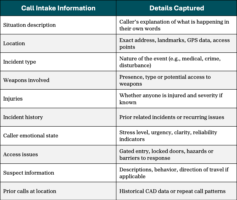
The cost to agencies is that triage recommendations for non-emergency and emergency lines are weaker than they should be. For example, a dispatcher who receives an emergency call may assign an incident type based on the resources needed rather than the full operational context.
CAD to Field (Mobile/MDT and Drone as First Responder)
Dispatch sends a unit to a call. The officer rolls out with whatever information made it into CAD, details that may be incomplete, outdated or already changed by the time they arrive on scene.
Conditions evolve in real time, but the officer’s understanding often does not. It could be:
- A domestic violence call where the suspect fled, but the update never makes it into CAD
- A medical call that escalates into a weapons-related situation, but the officer doesn’t know because the change happened in call intake, not in dispatch
- A traffic stop where new information surfaces through a records check, but it never reaches the field because updates require manual entry across systems
Drones operate in a similar disconnect when they are not integrated into the same operational workflow. A drone may already be airborne, capturing live situational awareness, but that intelligence often exists in a separate stream, viewed outside CAD and the officer’s decision loop. The result is the same problem; critical information exists, but it is not reaching the people who need it in time to act on it.
As a result, the cost is felt in the field. Officers are forced to make tactical decisions with only partial visibility, while critical details go unnoticed because the information existed somewhere in the system, but not in the moment it mattered. This is not a failure of the sworn and civilian personnel supporting the agency. It is a failure of systems connecting.
CAD to RMS
An incident is handled, and the officer writes a report in the records management system (RMS). That report contains details such as suspect information, property damage, injuries, evidence collected, witness statements and case disposition. All that data would improve future response to the same location or suspect.
But that information doesn’t flow back into CAD’s location history because CAD and RMS aren’t unified. As a result, the next call to that address doesn’t surface critical context such as, “You’ve been here 47 times in the past year,” “The last incident involved weapons,” or “There’s a dangerous suspect in the area.”
Without that context, dispatchers handle the incident with the same incomplete picture as before. Information makes its way into RMS, but it doesn’t flow back into CAD intelligence. That leaves agencies missing institutional memory when it matters most, with patterns that should shape triage buried in completed reports instead of informing live decisions.
Integrated Systems Close the Gap
Agencies operating integrated systems don’t have this problem. They’ve eliminated it.
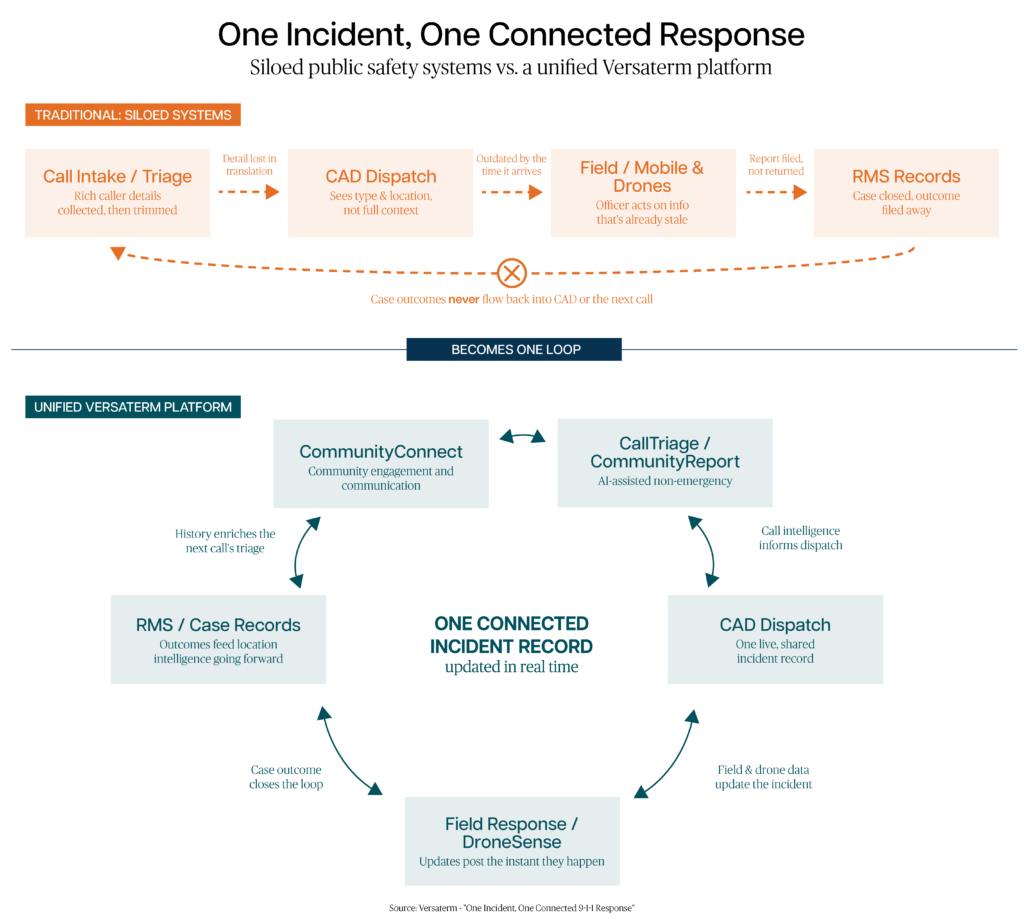
Call triage patterns flow directly into CAD
When patterns emerge across both emergency and non-emergency intake calls, that intelligence can immediately inform dispatch recommendations. The next dispatcher benefits not only from the details of the current call, but from insights drawn across thousands of prior incidents. This allows non-emergency trends to help shape emergency response, improving prioritization, awareness and decision-making in real time.
Field updates push back into CAD in real time
Field-generated intelligence flows directly into the CAD incident as it is discovered, ensuring that updates are immediately visible across the entire response. When new context is added from the field, it is reflected in the shared incident record rather than remaining isolated in notes or separate systems.
This real-time synchronization ensures that dispatch maintains an accurate, evolving understanding of the incident and can adjust resources and prioritization accordingly.
Drone operations contribute to the same continuous information loop, feeding live situational awareness into the incident record as conditions develop. Aerial intelligence becomes part of the same operational picture rather than a separate stream of data.
The result is a unified, continuously updated view of the incident where dispatch, field responders and drone support are all operating from the same details.
RMS feeds back into location intelligence
When a case is closed, its outcome feeds directly back into the system’s location history within CAD. Over time, this builds a continuously updated layer of institutional memory tied to specific addresses and call types.
When a new incident occurs at the same location, historical intelligence is surfaced at the point of triage. Dispatchers immediately see relevant context such as prior weapons involvement, drug-related activity or frequent caller patterns while making initial decisions.
This ensures that historical knowledge is not trapped in records systems but actively informing real-time response decisions.
When Every System Becomes One Workflow
This approach is the direction public safety operations are already moving toward: a fully connected platform where information is not recreated or lost between systems but continuously enriched across the entire lifecycle of an incident.
Within a unified platform like Versaterm, solutions such as Versaterm CallTriage, Versaterm CommunityConnect, Versaterm CommunityReport, Versaterm CAD, Versaterm RMS and Versaterm DroneSense work as one operational environment rather than separate tools.
Call intake intelligence flows directly into dispatch decision-making. Community members can shift appropriate reporting into digital channels through Versaterm CommunityReport and Versaterm CommunityConnect, reducing unnecessary call volume and improving access to services. Field activity and drone operations feed real-time situational awareness from Versaterm DroneSense back into Versaterm CAD. Versaterm RMS closes the loop by returning case outcomes into location intelligence that strengthens future response.
Instead of disconnected workflows, each interaction becomes part of a continuous intelligence cycle, where every call, report, response and outcome improves the next one and becomes the foundation of a connected 9-1-1 operation.
We welcome the opportunity to continue the conversation and explore how a connected public safety platform can support your agency’s operational goals.


