
The Investigative Record Behind Every UAS Operation
By Joe Malorgio, Solutions Consultant, Versaterm
For public safety agencies, every unmanned aircraft system (UAS) operation creates a record that remains important long after the mission is complete. Flight paths, telemetry, pre-flight documentation and other operational records can become important sources of evidence when questions arise about how, where and why an aircraft was used.
Questions about a drone flight may be raised for several reasons:
- A community member may want to know why a drone was used in a particular area
- A supervisor may need to confirm that the mission followed agency-established procedures
- A professional standards investigator may need to understand what happened during a complaint
- An attorney or public-records officer may need to find the records tied to that flight
- The FAA may have received a complaint alleging airspace violations
In each case, the challenge is fundamentally the same: Can the agency demonstrate what happened?
That question becomes difficult to answer when the available record depends primarily on retroactive reports or on the recollection of those involved. Human accounts remain important and can provide essential context, but they are not a substitute for objective reliable records of the aircraft’s actual operation.
An effective UAS program must consider more than what happens during the flight. It should also account for how the operation is documented, preserved and ultimately evaluated when questions arise. When those records are complete and reliable, agencies are better positioned to demonstrate how an operation was conducted and support the decisions that followed.
Moving Beyond Memory
Consider a complaint alleging that an officer used a drone to observe a residential backyard without justification. Without detailed flight records, an investigator may be left trying to piece together what happened from different accounts. While those perspectives can provide important context, they may not establish with any certainty where the aircraft is located, its flight path or its intended destination.
Comprehensive telemetry provides:
- Objective flight records
System-generated data captures the aircraft’s position, altitude, camera angle and flight path.
- A clearer account of events
Investigators can use telemetry alongside other mission materials to help establish what occurred.
- Mission and policy verification
These records help determine whether the flight was consistent with its stated purpose and applicable procedures.
- Evidence to support or refute complaints
Detailed records can substantiate or challenge concerns about how a UAS operation was conducted.
- Greater public trust
Transparent, objective records strengthen confidence in an agency’s use of UAS and demonstrate effective program oversight.
The goal is to create a record that allows agencies to understand what happened, demonstrate why it happened and show that the operation followed established expectations.
Accountability Begins Before the Flight
Strong investigations begin with standards that are established before the aircraft leaves the ground. When an agency has defined mission-authorization procedures, established pre-flight requirements and clear operating standards, those requirements provide an objective benchmark against which a flight can later be evaluated. Without that baseline, an investigation may be forced to rely more heavily on competing accounts of what was expected or intended, limiting its ability to establish the facts of the operation. Without this information, public trust can begin to erode.
Automated documentation strengthens that evidentiary foundation further by giving public safety agencies consistent, system-generated records across missions. These records document what occurred during a flight while preserving important context, such as whether the mission was authorized and how the operation was conducted.
Together, this full context provides investigators with a clearer basis for evaluating the flight:
- Flight data shows what the aircraft did
- Agency policies and standards define what was required
- Comparing the two helps investigators determine whether the operation was consistent with those requirements
The Structural Value of Automated Records
UAS programs that are successful depend on a consistent approach to documenting each operation. Manual documentation remains an important part of that process, while automated flight logging helps agencies create consistent records across missions and pilots. Together, they establish a more complete picture of each operation and a stronger foundation for review when questions arise.
That approach also requires consideration of how UAS data is protected throughout its lifecycle. As flight data and other digital evidence are collected, agencies need to understand where that information is stored. Strong data security and access controls help protect sensitive information while preserving the integrity and reliability of records used for review.
Different types of records serve different purposes:
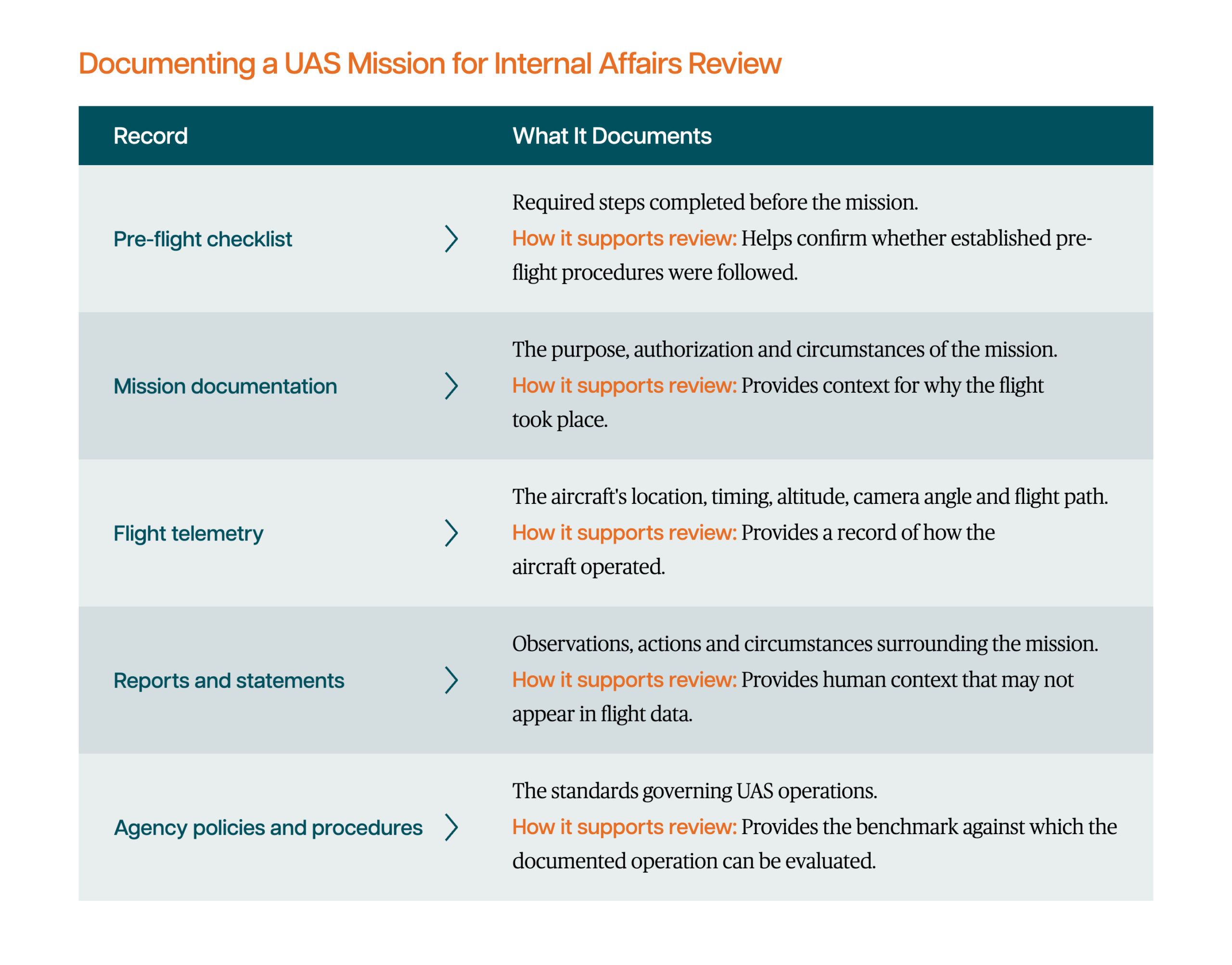
That value extends beyond the review of any single flight. When the same approach to documentation is applied consistently across missions, those individual records begin to build a broader picture of how an agency’s UAS program operates.
From Data to Institutional Accountability
The value of reliable UAS records goes beyond any single investigation. When agencies consistently document their operations, those records become part of the organization’s broader accountability framework. Over time, they can help create a clear history of how UAS resources were used and whether operations aligned with established policies and procedures. This record is what helps an agency establish that professional reputation.
Consistent documentation helps agencies:
- Support investigations with documented information about how a mission was conducted
- Apply standards consistently by giving investigators a reliable record to review across cases
- Respond to questions from supervisors, attorneys, elected officials, public-records personnel and members of the community
- Demonstrate accountability by showing how UAS operations are governed and conducted
- Maintain institutional knowledge even as personnel, pilots and leadership change over time
The result is more than a record of individual flights. It is an ongoing reflection of how an agency operates and oversees its UAS program.
Take the Next Step
The purpose of comprehensive UAS documentation is to make accountability part of the operation from the outset. A UAS program should be able to demonstrate not only where an aircraft operated, but what occurred during the flight, why the mission was authorized and whether the documented operation was consistent with the standards established to govern it.
See how Versaterm connects the records that support accountability across your agency and UAS program. Learn how Versaterm IAPro empowers agencies to manage and maintain reliable internal affairs records, while Versaterm DroneSense supports agencies in maintaining reliable records of UAS operations.
Schedule a personalized demo today to see how these capabilities work together to strengthen documentation, support investigations and build a more defensible operation.


